1987: A SPATIAL ODYSSEY INTO PRODUCTION DESIGN

By Luke Hicks

Eight minute read.

Introduction

I didn’t just make simple steps from metal work to prop making to set-hand to then taking the crafty leap of faith to designing film sets as a production designer, it goes much deeper than that. 

I eventually production designed for a BFI-packed short with Tom Blyth (Actor), Simon Dymond (Director, special FX and writer), Lauren Parker (Producer), Karl Poyzer  (DOP and Animator)  and actor  ‘Divorces’ singer/bassist Tiger Cohen-Towel for the 90s-based short film “Wash Club” A true story based on a series of events by writer Ross Sutherland) and tiny animation props for Coventry-born, Nottingham-based stop motion animator Allan Buxton. The beginning of all this was subconsciously taught very young. I’m currently pre-production designing my own short film, titled “Dreams pay”,

Early Life

I suppose for those who start in the arts, find, if they’re lucky, home becomes the first place for art to flourish. However, having lived in 14 different homes by the age of 19 in a state vagabondage postcode zigzagging across counties in England and witnessed the full-fledged nest mode of mum decorating constantly (often as a teen I would do murals on walls). When you’re a rootless single-parent family you adapt to different environments quickly. Within the rapid change of environments, something ignited in my imagination. I was able to imagine walls in different colours/borders, nooks were measured by eye for shelving and in the 90s, “Changing Rooms” helped me realise a lot can be accomplished in a small amount of time, albeit with a budget. Our family always was chasing cheap accommodation anywhere we could get so naturally when I production design I’m as thrifty and haggle-sum as they come.

Early film experiences

My first early life in film was making skateboarding videos in the early 2000s. This was more about showcasing musical taste set to the backdrop of a “non-sketchy trick” being accomplished on a digital camera. No sets as such, but a rapid change of environment from ollie-ing of the backs of flatbed lorries in depots, nose-sliding benches in school playgrounds over grass banks and simply 180ing over two stacked decks so clean it made that satisfying click-click when landing one truck after the other. The group I skated with were all better than I was. However, that didn’t matter we all had one minute each to make a seven-minute video in total being as there were seven of us and due to a lack of computer storage back when you dialled up your modems. I hope I’m making a parallel in this paragraph to how the mind needs to react quickly to changing environments and weather when filming anything within a team.

I didn’t know then that moving benches for nose sliding would eventually put me in good standing for shifting anything and everything to random places, for it is now a must for me to keep my necessary strength up for such heavy yet precious tasks.


Metalwork

After researching design ideas for a local Nottingham fashion brand, a material choice was made for a particular furniture project and (like my forefathers) it involved metal. Metal in the form of liquid aluminium to be precise, sand-cast for the furniture project for the fashion brand. I found kindred spirits at R and FD casting in Loscoe, Derbyshire. They took me under their wing we would talk in great depth about how sand-casting works. I was hooked. Sponging up liquid metal. A sort of young Magneto but more “Magsteeltoe” *clicks steel toe boots together*

My next project was casting parts for broken barber chairs for Bric in Nottingham, then casting a Microphone stand for “Mr B The Gentleman Rhymer” and a metal costume department prop for a Feature film ‘Adrift in Soho” where I acted as well as sand casting the character “Iron foot jacks” (You guessed it) iron foot. Albeit in Aluminium. I returned to Bric to do custom handles both inside and out, key holes and letter box. see below:

Feature film and televison experiences

I worked under Ellie Pash and her team on “Jamie Johnson” for a few weeks as a prop builder. Working for the BBC was a great experience from tinting window in a school gymnasium, moving daily from location to location, basic DIY  and creating a bespoke basketball backboard and net.

The first feature film I worked on as a prop maker was for “Adrift in Soho” where I made Iron Foot Jacks foot stilt as pictured:

I met Alex Doherty on the set of “Adrift in Soho” as the then production assistant and Steadicam operator. Now look what he’s accomplishing for the short film community with this very APP. I made a short film after Adrift in Soho with a third assistant cameraman and now DOP Guy Jenkins called “In Wilde’s words” which will hopefully be on this app soon. 


Masterclass in Production Design

My only formal bit of training came from the Production designer Grant Montgomery (Peak Blinders, Tolkien and Eastenders) who hosted, at the York film festival ‘Aesthetica’, a masterclass in production design for 2 hours. Speaking of how on “Peaky Blinders” he utilised the same space twice for two different scenes, which can all be done by the power of set dressing and imagination and a sublime use of resourcefulness. He believes production designing is a dark art, but I believe the opposite, for it is the inner light of the imagination where a production designers build their first storyboard and sense of scale. He called me an artisan after seeing some examples of my metal work, after the master class. The same metal work is available to see at Bric Squared Nottingham flying horse arcade in the form of handles, key holes and a letterbox.
 

Production designer for BFI-backed short WASH CLUB

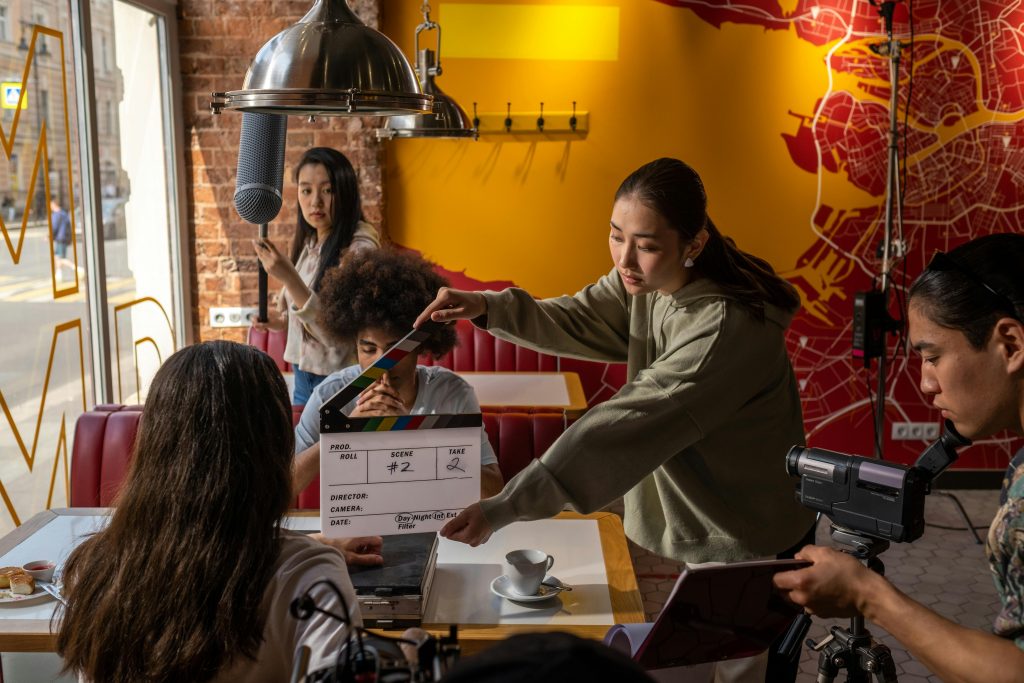
When sourcing the wood for sets for “Wash Club” I found two pounds for three metres of scaffolding planks that would have gone to waste from a construction site just off BBC island. My Set builder crew was able to halve the planks lengthwise which built the foundation for two set three-walled sets, one kitchen lounge and a bedroom. This really cut costs down on Wash Club and we then went on to use them for another short film. After that, they were used as dividers in mine and Alan Buxton’s studio on Canal Street Nottingham. Wash Club went. Since the film was set in the 90’s (the era I grew up in) sourcing things a military green Olympus voice recorder, a black Casio watch and old computer monitors/keyboards were things I could identify easily. Th most difficult prop was making a life size dummy to whirl around in washing machine to which me and the head of custom made of real clothes and a digitally printed fabric face and hands (the face ending up being the writers for a laugh: Ross Sutherland) The short was a success featuring on Vimeo editors pick of the week, racking up 500k views and also won an award at French film festival. Tom Bylth has gone on to star in Hunger Games!

Core Values for a Production Designer 

I believe a production designer should get stuck in with sweat, stage blood, and with peers (not actually blood or tears). So being the go-to for other departments pre, pro, and post is not just all mood boards and orders.

A transparent prop list connected to the script supervisor and the art department is a must.


Cost management is something, I believe, that is the hardest part. It’s hard because you want the least amount to go in the industrial bin. So, reusing set materials and handing out props as presents is my kind of thing.

Being eco-friendly includes using second-hand wood, where possible, for set building. Using paint from surplus paint charities. Buying second-hand where possible.  

Resourcefulness takes many forms: Asking friends to loan items, using scrap metal instead of new metal, and upcycling where possible. To cite an example, Star Wars’ Qui-Gon Jinn’s communicator was upcycled from a silver women’s Gillette razor with modifications.

Most of all, your team will make a prelist come to life. Their skills add their own vision to yours. The combination of different styles of making/building is what makes for a diverse-looking set.

final thoughts

To conclude, your own studio space is vital for attracting clients and experimenting with and storing set walls for future projects. Learning from your peers and elders is just as vital. Gaining experience at prop making, no matter how budget-conscious the job helps your portfolio. As the title suggests, “A Spatial Odyssey” your story is important to learning the ropes from home to film set to hopefully your own studio. I’m not a believer in the words “Big ideas” or “Dream big” because any production designer’s imagination whatever the size is vital to your success. Feel free to reach out to me for any help via our contact us. 


Special thanks to Carys Cook and Ben Humpherys

Scroll to Top